
DRATA ALTERNATIVES FOR ISO 27001 · A SMALL-BUSINESS REALITY CHECK
Two hundred integrations. You have eight.
Drata’s pitch is depth: automated evidence from hundreds of systems, continuously tested. For a company with a security team and a sprawling cloud estate, that is worth the money. For a fifteen-person SaaS firm with Google Workspace, AWS, GitHub and a handful of SaaS tools, most of what you’re paying for sits idle. This page is about the gap between the two.
DRATA, TYPICAL SMALL-COMPANY CONTRACT
$12,000 to $28,000 / year
Reported range for companies under 50 staff, from procurement data on over 200 Drata contracts (2026). Median across all buyers about $25,000. Entry tier reported from around $7,500.
ISO 27001 IN A BOX
£295, once
A complete ISMS in Notion: plan, SoA, 46 documents, 12 registers, video guides. Single-organisation licence. Built by an ISO 27001 Lead Auditor.
Drata is a good product. I want to say that early, because what follows is going to sound like I’m against it, and I’m not. I’m against small companies buying it for the wrong reason, which is usually that a customer asked for ISO 27001, the founder searched for “ISO 27001 software”, and Drata’s sales team was very good at their job.
I’m a certified ISO 27001 Lead Auditor. I implement and audit the standard for small businesses, and I’ve sat on the other side of the table from companies who arrived at their Stage 1 audit with a Drata dashboard full of green ticks and no idea what their ISMS scope was. The platform had done exactly what it promised. It just wasn’t the hard part.
Evidence collection is the part of ISO 27001 that was never difficult. Deciding what you’re protecting, from what, and how much is enough, is the part that is.
THE PRICE
What Drata costs a small company
Drata doesn’t publish prices, and the quote you get depends on headcount, the number of frameworks, how many systems you connect, and how close it is to the end of their sales quarter. The figures below are from procurement platforms that track real contracts, not from Drata, and they’re US dollars because that’s how Drata sells. Treat them as orientation and always get a written quote.
| What’s being measured | Reported figure | Source and date |
|---|---|---|
| Companies under 50 staff, platform only | $12,000 to $28,000 / year | Vendr, 237 contracts, Feb 2026 |
| Implementation services on top | $5,000 to $20,000, first year | Vendr, Feb 2026 |
| Median contract, all buyers | $25,000 / year | Vendr, Feb 2026 |
| SMB average (50 to 1,000 staff) | $22,942 / year, up 6.5% on last year | SpendHound, 160 contracts, Oct 2026 |
| Entry tier, single framework | from about $7,500 / year | Third-party tier reconstructions, 2026 |
| Certification body audit (any route) | $15,000 to $40,000+ per year, paid to the auditor | Every source; never included |
In sterling, at £1 = $1.25, that’s an entry point around £6,000 a year, a typical small-company contract of £10,000 to £22,000 a year, and a median of £20,000. Over a three-year certification cycle, the realistic small-business number is somewhere between £30,000 and £65,000 before you’ve paid an auditor. The entry tier exists, but the procurement data suggests few small companies end up on it once frameworks and integrations are counted.
WHAT YOU’RE PAYING FOR
The integration count, and why it matters less at 15 staff
Drata’s strongest feature is the breadth of its integrations. Connect your cloud provider, identity provider, source control, HR system, device management and ticketing tool, and Drata tests them continuously: is MFA enforced, are laptops encrypted, has every new starter completed training, are there unreviewed pull requests to production. When something fails, you’re told. At audit, the evidence is already there.
That is a real saving, and it scales with the size of the estate. A 300-person company with twelve AWS accounts, three identity providers and a security engineer who’d otherwise spend a week each quarter screenshotting console settings gets its money back. Now picture the company that actually asks me about ISO 27001: fifteen people, Google Workspace, one AWS account, GitHub, Slack, a password manager, maybe HubSpot and Xero. Eight systems. Collecting evidence from eight systems by hand takes an afternoon a quarter, and you’d know your own configuration better for having done it.
You’re paying for the two hundred integrations whether you use eight or eighty. That is the pricing model, and it’s a perfectly fair one for the customers it was designed for. It just wasn’t designed for you.
WHAT’S NOT IN THE BOX
What Drata doesn’t do, because no platform can
The parts of ISO 27001 that fail Stage 1 audits are almost never evidence. They’re thinking. Drata gives you policy templates, but someone still has to decide which of them apply, strip out what doesn’t, and make them describe how your company actually works. Specifically, the platform cannot:
- Scope your ISMS. Which parts of the business, which locations, which services. Get this wrong and everything downstream is wrong.
- Run your risk assessment. Drata has a risk register. It doesn’t know what your risks are, how likely they are, or what you’ve decided to tolerate. That’s a conversation, not a scan.
- Write your Statement of Applicability with reasons. Ticking 93 controls is easy. Justifying each inclusion and exclusion in terms an auditor accepts is the work.
- Decide what’s proportionate. A platform tests against a fixed bar. The standard asks you to set your own, and defend it. Small companies that let the tool set the bar end up with controls they don’t need and can’t sustain.
- Hold the management review, run the internal audit, or chair the meeting. It can remind you. Someone still has to do it.
That list is the ISMS. The platform is the filing cabinet around it, and a very good filing cabinet. ISO 27001 in a Box is the ISMS already thought through for a small, cloud-first company, with the filing cabinet built in Notion for free.
COST OVER ONE CERTIFICATION CYCLE
Three years, single framework, entry-level pricing
Certification runs in three-year cycles, so that’s the honest window. The chart uses entry-level platform pricing; the procurement figures above suggest most small companies pay more than this.
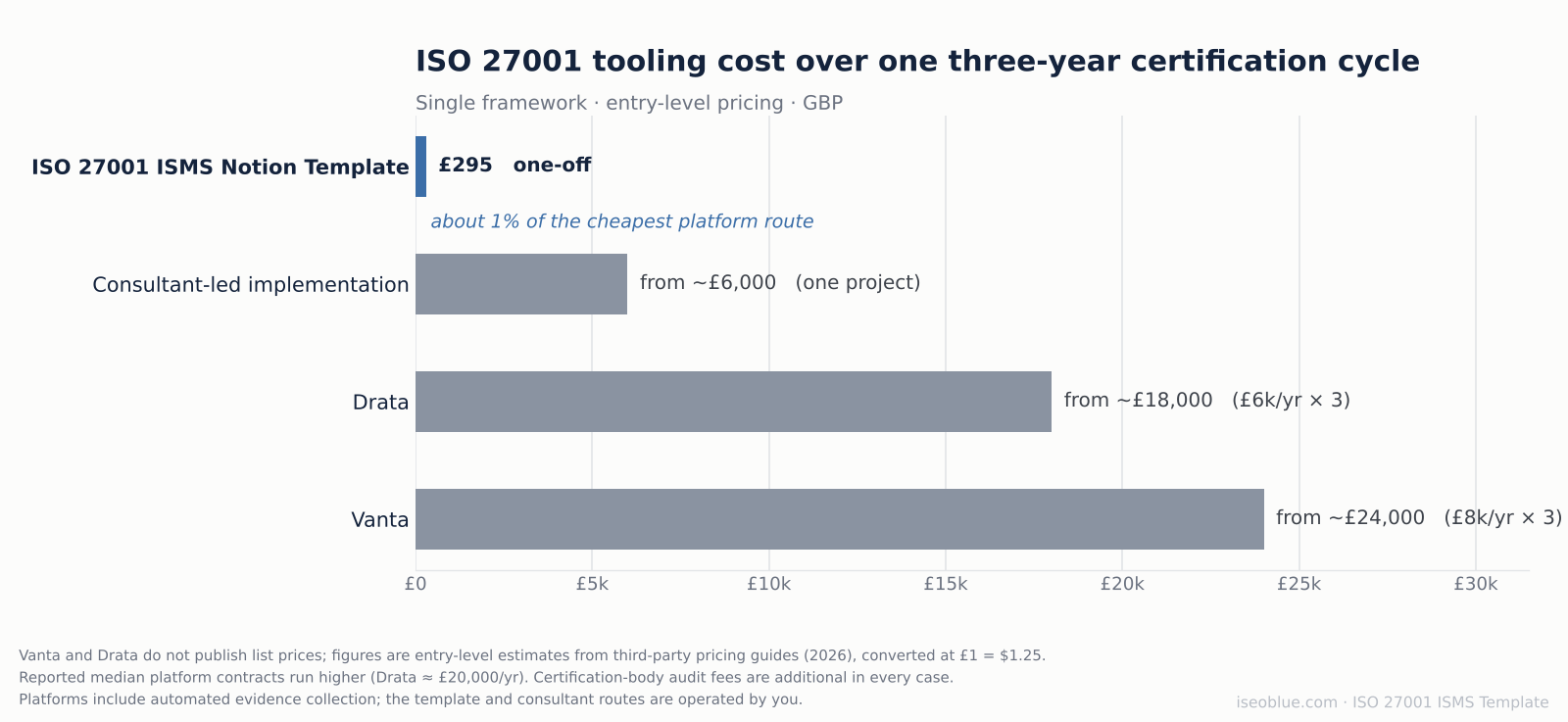
Vanta and Drata do not publish list prices; chart figures are entry-level estimates from third-party pricing guides (2026), converted at £1 = $1.25. Reported median Drata contracts are around £20,000 a year. Certification-body audit fees are additional in every case. Platforms include automated evidence collection; the toolkit and consultant routes do not.
THE ROUTES
Three ways a small company gets to ISO 27001
| Route | Cost | What you get | Still on you | Suits |
|---|---|---|---|---|
| Drata (or Vanta, Secureframe) | £10,000 to £22,000 / year typical; entry from ~£6,000 | Continuous automated evidence from connected systems, policy templates, control tests, auditor portal, multi-framework mapping | Scope, risk assessment, SoA reasoning, tailoring every policy, running the meetings, the audit itself | 50+ staff, SOC 2 as well as ISO, complex cloud estates, US enterprise customers who expect continuous monitoring |
| Consultant-led implementation | from ~£6,000, one project | Someone who has done it before scopes, assesses and documents it with you, and prepares you for audit | Your time in the workshops, keeping it alive afterwards | No internal capacity, hard deadline, or a buyer who wants it done properly first time |
| ISO 27001 in a Box | £295 one-off | A complete ISMS in Notion: 46 documents pre-drafted, 12 registers, SoA, implementation plan, video guides, cross-linked to every clause and control | Working through it: the plan tells you what, the videos tell you how | Under 50 staff, cloud-first, someone sensible with a few hours a week |
These aren’t mutually exclusive. Companies that outgrow the Box often move to a platform later, once they have the headcount and the second framework that make it pay. What they take with them is the thinking: the scope, the risk method, the SoA reasoning. That transfers. The subscription doesn’t.
THE HONEST PART
When Drata is the right answer
Buy Drata if
- You need SOC 2 and ISO 27001 together, or HIPAA or PCI after that. Mapping one set of evidence to several frameworks is where Drata genuinely earns its fee.
- Your infrastructure is complex enough that manual evidence collection is a real job: multiple cloud accounts, several identity providers, a fleet of devices.
- Your customers are US enterprises whose security questionnaires ask about continuous control monitoring, and a trust page with live status closes deals.
- You have, or are about to hire, someone whose job includes compliance. The platform makes that person more effective. It doesn’t replace them.
Don’t buy it yet if
- You’re under 50 people with a single cloud account and a short list of SaaS tools. The integrations you’d use fit on one hand.
- ISO 27001 is the only framework on the horizon. Multi-framework mapping is the platform’s best trick, and you wouldn’t be using it.
- One customer asked for the certificate. Spending £20,000 a year to win a £30,000 contract is a decision, not a default.
- Nobody in the company has yet worked out what the ISMS is for. Buy the thinking first; the tooling is easy to add later.
If you’ve been quoted by Vanta rather than Drata, the same logic applies with slightly different numbers; I’ve written that up separately in Vanta alternatives for ISO 27001.
THE ALTERNATIVE
The ISMS, already thought through
ISO 27001 in a Box is the system I’d build for a small, cloud-first company if I were doing it from scratch for them, which is because I have, several times. Every policy is pre-drafted for a business like yours. Every control in Annex A is mapped. The risk register arrives with worked examples. The implementation plan tells you what to do in what order, and the video guides show you how. It lives in Notion, where you already keep everything else, and it costs less than an hour of a consultant’s time.
£295, one-off
Questions people ask before choosing
Is Drata cheaper than Vanta?
At the entry tier, slightly: third-party guides put Drata’s starting point around $7,500 a year against Vanta’s $10,000. Once you look at what small companies actually sign, the gap closes. Procurement data for 2026 shows typical Drata contracts for companies under 50 staff at $12,000 to $28,000 a year, with a median around $25,000 across all buyers. Neither publishes prices; get written quotes from both and compare like with like.
Does Drata include the ISO 27001 audit?
No. Drata, like every compliance platform, prepares you and collects evidence. Certification is issued by an accredited certification body after Stage 1 and Stage 2 audits, which you pay for separately. Budget $15,000 to $40,000 for the audit cycle on top of any platform or toolkit cost, depending on your size and the body you choose.
Can I start with ISO 27001 in a Box and move to Drata later?
Yes, and it’s a sensible sequence. The Box gets the thinking done: scope, risk method, Statement of Applicability, tailored policies. If you later grow into a second framework or a complex estate, a platform can import those policies and take over evidence collection. The subscription you avoided in years one to three is money you didn’t spend while you were small.
Will an auditor care that I used Notion instead of Drata?
No. Auditors assess your ISMS against the standard, not your choice of tooling. They want to see documented scope, a risk assessment, a Statement of Applicability, operating records and management review, and evidence that controls work. Where that lives is irrelevant provided it’s controlled and retrievable. Thousands of certified companies run their ISMS in documents and spreadsheets.
What does Drata do that a Notion ISMS can’t?
Continuous automated testing. Drata connects to your systems and checks controls on a schedule: MFA enforced, disks encrypted, access reviews done. A Notion ISMS records that you checked; Drata checks for you. For a small estate that’s an afternoon a quarter by hand. For a large one it’s a job, and that’s when the platform pays.
Is a £295 product too cheap to be any good?
It’s cheap because it has no sales team, no servers and no subscription to defend. The content is the same ISMS structure I build for consultancy clients at £750 a day, packaged so you can run the project yourself. If you’d rather I ran it with you, that service exists too, and the Box is where we’d start.
Pricing sources: Vendr Drata marketplace data (237 contracts, updated February 2026); SpendHound Drata pricing (160 contracts, updated October 2026); Sprinto and FeeGuides tier reconstructions (2026). Drata does not publish list prices and all figures are third-party estimates. Drata is a trademark of Drata Inc.; Iseo Blue has no affiliation with Drata.